Beyond the Storm: Why 2026 is the Year of the Lebanese ‘Empowered Citizen’

As the sun sets on another year, I am reminded of an old maritime analogy: a captain cannot control the storm, but he can absolutely control how he shifts the sails. In Lebanon, we have spent a few years battling a hurricane, yet as I look across my window overlooking beautiful Beirut, I don’t see a shipwreck. I see a fleet of resilient, empowered citizens ready to catch the first winds of change.

For me, 2025 was a year of building transformative resilience. Whether I was in boardroams with development sector executives through RPS MENA, or with private sector representatives as part of the Lebanese Private Sector Network (LPSN), convening our local Consulting Community of Practice, or mentoring aspiring youth of Aie Serve and connecting with WEF’s Global Shapers locally and globally, one truth became undeniable: The era of the “waiting citizen”, the survival mode is over. The era of the “Empowered Citizen” has begun.

From Survival to Strategy

For too long, we’ve defined progress in Lebanon as mere survival. But survival is not a destination; it’s a baseline.

My vision for a brighter tomorrow for myself and my children isn’t based on a gift from abroad or on some decision by a foreign government to give us a break. It is based on self-reliance, reason, building a sense of agency among Lebanese, and respect for the law. We often talk about “Social Justice” as a handout, but I see it as an essential right and a source of empowerment. Through my work with the Youssef Tabsh Foundation and RPS MENA, I’ve seen that when you provide a citizen with the right tools, access to a community, and opportunities, they don’t just survive, they build and thrive. Citizens with agency, a sense of social justice, rule of law and a common vision are capable, empowered citizens who can make wonders.

We need state and non-state actors in Lebanon that act as regulators and enablers. A country where a young professional, for example, doesn’t need a “wasta” to thrive; they just need a functioning system, a digital/unified ID perhaps, and a sense of security that comes from a stable, growth-oriented economy. They don’t need hand-holding or someone telling them what to do; they just need a paved way in front of them, and they’ll figure it out.

Conveners & Builders

My belief is that for the coming period, we need people who serve as conveners and builders. Not “political representatives” in the old sense, but individuals from across the Lebanese mosaic bringing people together, and to rally everyone to a shared vision, narrative, dream, to take action and build. We need thought leaders, nation “rethinkers”, and reform inspirers for a more just system.

I believe the top priorities would be:

  • Architecting a New National Narrative: The days when Lebanon was “Switzerland of the Middle East”; the banking, health, education, and hospitality center of the region are long gone. We need to envision a new “value proposition”, an inspiring set of “differentiating factors”, and an innovative “modus operandi”. Lebanon 2050 should be something we can all envision, work towards, and get inspired by.
  • Engineering Blueprints: Moving beyond “protest” toward “policy”, beyond “rhetoric” toward “action”. We need to double down on practical, technical, law-based frameworks that are simple, understandable, and implementable. From anti-corruption to fiscal decentralization, from foreign policy to economic strategy, ensuring that our “institutional health” is the priority and our citizens are at the center.
  • National Self-Reliance: Championing a “positive neutrality” where Lebanon leverages its greatest asset, its citizens, whether local or the diaspora, to build an economy that can withstand global shocks. I’m all for having friendships and positive diplomatic relations with Arab states and others. Still, we should plan to grow independently of foreign investment and aid and focus more on our capabilities, which are plentiful.
  • Empowering the Middle: Continuing to convene the academicians, thinkers, professionals and experts who are the backbone of this country, and encouraging those who travelled to return and build the dream with us, is of utmost importance. If we move in sync, we move the nation.

A Message of Hope: The Lebanese Mosaic

Hope, in the Lebanese context, isn’t blind optimism. It is the calculated belief that our diversity, our “mosaic”, is our competitive advantage. When we finally detach our public posts from confessional quotas and attach them to KPIs and merit, we don’t just fix the government; we heal the nation. More than 18 years ago, a team from all walks of life that co-founded Aie Serve believed in the values of respecting, accepting, and loving others, and today those values are more important than ever.

To my fellow Lebanese, at home and in the diaspora: do not let the headlines dim your light. We are a nation of “Good Shepherds”; we are dreamers, builders, creators, and consultants, ready to charter a new way forward for our own destiny.

Let’s step into 2026 not just hoping for change, but engineering it; each of us in our own sphere. By convening when dialogue is needed, contributing expertise were it is missing, mentoring the next generation, choosing institution building and practical actions over slogans and promises, we can quietly but deliberately reshape our shared future.

Afif Tabsh

http://www.LinkedIn.com/in/AfifTabsh

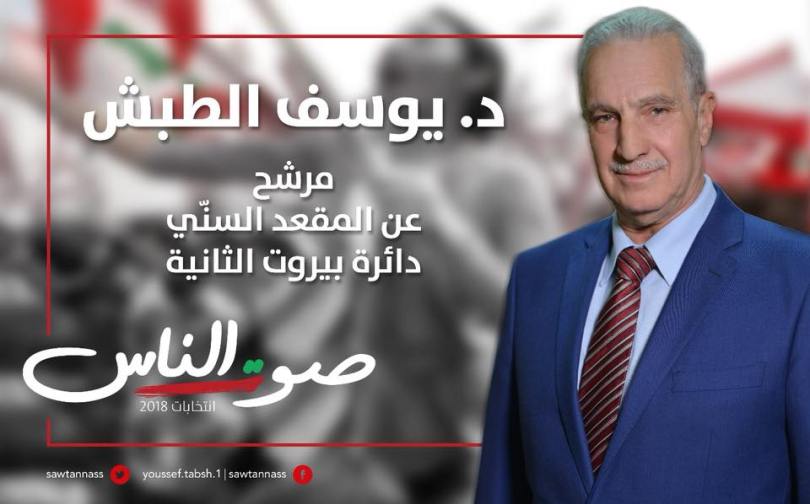
Interview with Dr. Youssef Tabsh – Lebanese Parliamentary Candidate 2018

29136052_174482046507007_1178572907012517487_nDear Reader,

As a start, I have a disclaimer to make: Dr. Youssef Tabsh is my father and is currently running for parliamentary elections in Beirut II district. The aim of this post is to objectively reflect my father’s responses to questions and concerns which matter to the Lebanese citizens in general, and more specifically, Beirut community.

The questions mentioned below have been curated through my personal network, then merged, edited and phrased in such a way as to reduce any redundancies and overlaps while ensuring that all key inquiries are addressed.

In addition to the Q&A below, I’m adding a link to the Electoral Program of “Sawt El Nas” the coalition which Dr. Youssef Tabsh is part of.

You can also follow his Facebook Page on: Dr. Youssef Tabsh Friends (Elections Campaign Page)

About Dr. Youssef Tabsh

Dr. Tabsh is a medical doctor; a uro-surgeon to be exact. He is the youngest of his 5 siblings descending from a typical Sunni family residing in Tareeq El Jdide in Beirut. He has been very proactive in civic welfare matters since he was 14. Dr. Tabsh pursued his studies at Makassed and Al Bir Wal Ihsan schools respectively. Later, he obtained a scholarship to pursue his medical education at the First Institute of Medicine in Saint Petersburg (previously Leningrad), Russia  where he also headed the Arab Students Association.

Upon his return, he registered at the Lebanese Order of Physicians as well as the Lebanese Urology Society. He then opened his clinic, started his medical practice in several local hospitals, joined the Soviet Union Alumni Association in Lebanon which he was then elected as its President. Dr. Tabsh served as a founding member of the Mourabitoun (المُرابِطون) political party, and Vice President at the medical foundation called “Najda Sha’bia” (النجدَة الشعبية). Additionally, he was a founding member and then elected President of the Lebanese National Crescent(الهلال الوطني اللبناني). He is also a founding member and Vice President of an NGO which civilizations studies organization called “Tayyar El Hadarat Abhath wa Dirasat” (تيّار الحضارات-أبحاث ودراسات)

In the aftermath of the civil war, Dr. Tabsh put his political engagement on hold and focused solely on humanitarian work and medical practice. In the 90s, he ran for Presidency of the Order of Physicians.  From a broad geo-political perspective, Dr. Youssef Tabsh strongly believes in Arab nationalism, the Palestinian cause, a fan of Jamal Abdul-Nasser’s socialist views and approaches, and a vigorous advocate of freedom of expression and humanitarian work.

Over the past 37 years, Dr. Tabsh had helped and supported thousands of people in need across all spectra of the country; whether sick, impoverished, or in trouble. His medical and humanitarian services ranged from Beirut, to Saida, Palestinian camps and other various areas in Lebanon where there were people in need.

Currently, Dr. Youssef Tabsh is a retired medical doctor, a loving husband, a father of 4 and a grandfather of 3. He speaks 4 languages, is an avid reader and a strong believer in lifelong learning. He still has that flame in him; that passion and vision to serve his community, his country, and the Arab nation at large by any means and by all means within his capacity. His activism since childhood stands proof to it.

Q&A

After that many years of not being in the political scene, why did you decide to run for elections?

As a matter of fact, my lifelong friends Brigadier General Moustafa Hamdan from the Mourabitoun movement (حركة المرابطون) and ex-MP Najah Wakim from Haraket El Sha’b (حركة الشعب) both asked me to run for elections as they strongly believed in my vision and political agenda while feeling that there is a real chance to succeed with the new electoral law. Based on multiple discussions and meetings, I felt it would be worth to give this step a shot, and I definitely look forward to further serving my country.

When people hear “Mourabitoun” they recall the armed group that was based in Beirut defending against the Israeli invasion. To what extent does the current Mourabitoun movement still resemble its history, and what has changed since then?

The days of armed groups have long been gone; I’ve never been a fan of arms, never used one and not planning to ever own one. Eventually, I’m a medical doctor; I have solemnly sworn to save people’s lives not end it. The Mourabitoun today has kept its core values of Arab nationalism, believing in the Palestinian cause and their right to return to their homeland, and in the socialist agenda of having fair and just policies applied to all citizens within the country regardless of their sects and affiliations. This is the core belief of the Mourabitoun movement. This is what it has been reestablished to do, and this mission will survive despite any challenges.

You are part of a coalition called “Sawt El Nas” or the “Voice of the People”, why this coalition?

As a coalition, there are a lot of common ground among us. It is true that we come from diverse backgrounds and political parties/civic groups, but there is synergy among the members on many core issues, all of which are reflected in our common “Political Program for Parliamentary Elections”.

Can you summarize your political agenda in few bullet points/key words?

The agenda, or political program in general, is quite detailed. However, if I were to highlight the key issues/topics which constitute top priorities for me, they’d be as follows:

  • Secularism: Pushing to end sectarianism in any and all means possible; hence, ensuring citizens are treated equally and fairly, irrespective of their religious affiliation.
  • Rule of Law: Developing necessary policies, and spreading awareness about the importance of institutionalization, good governance and proper functioning of public entities to serve citizens properly, consistently and fairly.
  • Transparency: Activating and empowering the proper institutional bodies to monitor, audit and hold accountable all public servants (from President to Ministers to MPS to all those who work in the public domain) as a means to combating corruption in a structured, consistent and sustainable manner.
  • Knowledge Economy & Employment: Initiate new government projects, open new positions, reverse the brain drain and enforce policies which encourage recruiting fresh graduate Lebanese, people with disabilities, and enforce certain female quotas.
  • Health Care: Ensuring healthcare services are accessible, affordable, of high quality and treat all Lebanese people with courtesy, irrespective of whether or not they have money.

What is your stance of the current political parties who are in power?

They are a disgrace to the country. They have been in control of this country since the civil war; many just changed hats from war-lords to governmental figures. It is a shame that Lebanese citizens have consistently voted them back into office time and time again. There is a saying in Arabic that somewhat means “Your leaders are a reflection of who you truly are” and that shows that some Lebanese people still believe in those “leaders” and they represent them, or else why would they vote for them? That shows that a non-representative percentage of the Lebanese population are sectarian, corrupt, short-sighted, promote their own personal benefit over that of the country’s. Yet, and thankfully, not all Lebanese are like that, and with this new electoral law, we all have a chance to make a difference, of putting people in office to voice out our concerns, and represent us as we deserve to be represented.

Can you walk us through your political program and plans if you become an MP?

Well there are many points to talk about here, so I prefer if you read the program in detail (link) as it covers topics including but not limited to: Foreign policy, Empowerment of the Army, Jails & Justice Department, Sectarianism, Right to Give Nationality to Children by Males and Females, Female Quota, Rights of the Disabled, Brain Drain & Economic Recovery, Knowledge Economy, Healthcare, Education, Unemployment, National Debt, Economic Policy, Fighting Corruption, Garbage & Other Environmental Issues, Electricity, Internet, Telephone & Other Services, and Transportation among other topics.

Anything else you’d like to tell the readers?

Well I want to tell your readers, especially those in Beirut, that their vote won’t go in vain. Each vote counts, every person who steps forward and practices their civic duty is helping shape the future of the country in a way they find fit. I hope that through my bio, my replies, and the program I shared with you above, I will have managed to convince your readers to vote for me. All those who know you, my son, whether personally or through your work, I believe they know what kind of person you are and what kind of upbringing you had. It is the same vision, support and encouragement which I had provided for you that I would like to offer to the youth of this country; give them hope, provide them with decent careers, bring them their country back from the bunch of people who have been taking us hostage for over 30 years now!