5 Dos & Don’ts of Leading Volunteers

Being a volunteer myself involved in leading volunteers, I get to reflect often on how things are done and how to improve.

It is without doubt that leading volunteers tends to be tricky as you’ll have to ensure motivation and commitment are high at all times. Moreover, you’ll need to take care of the feelings and aspirations of the volunteers, no matter how young or old they are.

So to make things simple, I am going to share with you 5 Dos and 5 Don’ts in managing and leading volunteers:

Dos:

  • Thank volunteers at every milestone, every good report, every job well done. There is no upper limit of how much you can thank them and how. It can range from a simple thank you email, a tap on the shoulder, to inviting them for a free dinner/lunch/get-away.
  • Give volunteers space to make decisions and have a say in what is being done. Barely anyone likes to do donkey work or to simply follow steps given, let the volunteer role be more demanding and challenging.
  • Lead by being a role model, show the way and be the first to step up for action. It takes people a very short time to realize preachers from doers.
  • Follow up, follow up, follow up… oh and did I say it’s important to follow up? You wont imagine how smooth things will go if you just remind people if they missed something ,follow up on tasks to be done and make sure things are progressing as planned. If you just sit there and expect volunteers to get things done without any follow up..at least at the beginning, then you’ll be surprised.
  • Be friendly, polite and respectful. Yes they may seem trivial, but so many times discussions, emails or meetings can become tense, issues urgent, stakes high…that you might lose your temper, say something mean, be a bit harsh or disrespectful. Once you do that..you know you’re going to lose some one from the team or lose their trust and respect to say the least.

Don’ts:

  • Don’t underestimate any volunteer’s abilities, knowledge, network or creativity. You’ll be surprised with how much people can do when you believe in them.
  • Don’t blame or criticize volunteers publicly. Keep morale high and respect of others to each other and to yourself, if you have something negative to say…say it one-to-one.
  • Don’t take all the credit. Give credit where credit belongs… if the team is doing a good job, you owe them the credit, not yourself.
  • Don’t be biased for personal reasons. Give work, credit or thanks for those who are doing work…not for those you like or you’re friends with.
  • Don’t keep information hidden to yourself. Sharing knowledge, experience, information, contacts ..etc. with your  team is key to show them you trust them and to empower them with what they need to lead…to become self-motivated and self-managed.

I hope those few things help you out! 🙂

Other Interesting Posts:

Project Management for Entrepreneurs

I have been doing some enthusiastic research on the topic, and I have come to realize that most of the current corporations and governments are not being able to provide enough jobs for the hundreds of thousands of young Arabs who graduate every year. Besides, those amongst them that were planning on emigrating lost their chance to travel to the US or Europe for dream jobs due to the economic downturn.

With 60% of the Arab nation being under 30 years old, the number of educated individuals is rising, and yet the supply of jobs is inadequate. In this context, numerous institutions, banks, and government agencies are focusing on fostering entrepreneurship among youth.

Consequently, hundreds of startup projects and initiatives are being launched annually by young entrepreneurs who have the education, the idea, the drive, but lack the experience and the systematic approach to enhance their chances to succeed in their ventures.

This gap has certainly led to numerous failed initiatives, shattered dreams, and lost investments. Imagine all those young aspiring youth, full of enthusiasm and creativity, but crushed by their own inability to drive their business enterprises to success.

The fact is, good ideas are a dime a dozen. The true value is in the ability to transform those ideas into reality…and rare are those that have the intrinsic knowledge to go through the process. In this context, I have realized that project management skills, knowledge and tools come in very nicely to fill a gap for the aspiring entrepreneurs and empower them to be able to transform their ideas into a reality.

So after some well-thought of analysis, I have pinpointed 5 project management mantras from which entrepreneurs can surely benefit from:

  1. Ability to clearly define the scope of their startups, products, services and communicate it clearly.
  2. Knowledge of how to break down the scope of work into clear and comprehensive work packages, schedule the work packages, and work on a budget accordingly.
  3. Skills in recruiting the right people, engaging them, and motivating them to work synergically.
  4. Communication skills with main focus on unifying terminology used, choosing the proper communication channels, and disseminating the right information.
  5. Expertise in understanding possible risks that are inherent to new ventures and ways to manage them. This usually becomes better with time…trial and error being the best tutor.

That’s what I have in mind so far, I hope it helps. Knock them out!


Other articles that might be of interest:

Systems Thinking: Understanding the Complexity of Our World

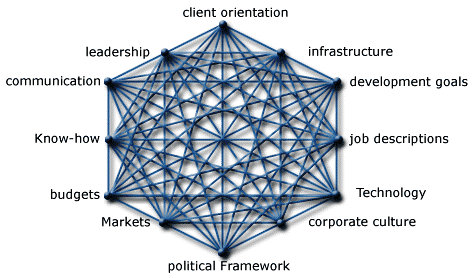
Systems Thinking is based on the field of system dynamics, founded  by MIT professor Jay Forrester in 1956. The idea behind systems thinking is to be used when analyzing change, interventions and solutions to consider how the component being under study is interacting with other components in the system.

So for example, if we’re trying to introduce new roles in the organization or solve a social issue or introduce new projects and initiatives in the community or organization…we need to consider how those interact with other parts of the system. Many of the traditional methods take a sequential approach to analyzing issues, systems think
This leads us to actually ask, what is a system? Well in a nutshell, a system is a group related, interdependent, bound and related components that interact together. So the computer you’re using is a system, organization you work in is a system, the city you’re in is a system, the country you’re in is a system. In this context, systems can be a “component” of a bigger system. Thus our world is constantly interconnected and has multiple influences from the broader system on the smaller ones, and vice versa.ing on the other hand focuses on the big picture and how are it’s components interacting thus a more complex and iterative approach.

For example, the company’s “system” is made up of:

  • Policies & Procedures
  • Human Capital
  • Facilities & Equipment

So to introduce a change in one of those 3 elements, whether it’s team performance or overall cost reduction, there will be an impact on the other 2 elements and thus in many organizations instilling some change in one element will end up leading to un-expected changes in the other and thus the “original” problem would be resolved, but other problems would’ve popped up.

The key benefit of Systems Thinking is that it provides a better way for analysis and for solving most complex problems that are plaguing our world from governments to communities to business and so on.

Systems Thinking is being used in very wide spectrum of fields today and this proves that the people are becoming aware of it’s value. Some of the fields where it is being utilized are:

  • Engineering & Construction
  • Management & Consultancy
  • Environment
  • Health & Medical Services
  • Manufacturing & Industry
  • Business Analysis
  • Project Management
  • Policy Making & Governance
  • Community Development
  • Computing & Information Technology
  • Sustainable Development

In conclusion, with the increasing complexity of our world today it becoming a necessity to be able to see the “big picture” and understand the systems we are working with or else our proposed solutions and improvements will fail to reach the impact expected with long lasting sustainability.

Project Management for NGOs: Lecture Given to PMI Lebanon Chapter

Last month I’ve given a lecture/session titled “Project Management for NGOs” to the PMI Lebanon Chapter as part of their monthly lectures.

In this context, I thought of sharing it with you. So below you’ll find the session description, learning outcomes and the link to download the presentation for your own knowledge and entertainment…. let me know what you think! 🙂

Session Description/Summary:

The world today has hundreds of thousands of active NGOs majority of which are project and program based and depend on ongoing grants and funding to secure resources for their projects. With grants and funding summing up to hundreds of millions of dollars annually, the amounts being lost on failed projects, unmet objectives and re-work is counting up to tens of millions of dollars.

Many leaders of NGOs consider this as a reasonable and un-escapable price to pay due to the fact that it is hard to recruit enough qualified project and program managers in the NGO field due to the short period of engagement, low wages with respect to private sector and lack of well identified project management training, tools and techniques.

With thousands of program managers, program coordinators, project managers, project coordinators, assistant program and project managers and so on and so forth, there is a huge gap to be filled for both the organizations and the individuals working in them.

What many don’t realize is that PMP standard can apply to NGOs by simply matching many of the terminology that is used by PMP with those present in NGOs. This lecture will help you understand how.

Lecture Learning Objectives:

  • Understand and Define an NGO
  • Identify the Numerous Types and Fields of Work of NGOs
  • Understand the NGO Project Life Cycle in Most NGOs
  • Map NGO Project Related Terminology with PMI’s Terminology

Link to Presentation in PDF: PMI Leb Chapter – PM for NGOs Presentation by Afif Tabsh – April 2012

Other Posts Worth Reading:

NGOs, Project Management & Serendipity

NGOs play an essential and integral role in the sustainability and growth of our communities and environment. They deal with a wide spectrum of topics including but not limited to orphans, elderly, recycling, global warming, advocating rights, economic development, education, awareness…etc.

For more than 12 years, I’ve been passionately involved in NGOs and along the road I managed to create some, or be on the Board or advice & consult others. Throughout the years, most of the NGOs I’ve known have been managing projects and programs. They design projects, write proposals & budgets, implement projects, evaluate them and so on and so forth. Yet I long to see some common project management terminology, standards or methodology on how to do all this.

Years ago, the private sector has identified certain standards for project management, best practices, processes, tools, techniques..etc. These standards are helping corporations in all shapes and sizes, from the multi-nationals to the small local enterprises, in achieving their projects on time, within budget and fulfilling the necessary scope. Yet, surprisingly, and in-spite of the fact that most NGOs work on projects; we somehow missed the idea of having an agreed on, industry-wide standard, best practices and methodology . So you might ask yourself and what if we don’t have a standard, what does it really matter? The fact is, many NGOs miss essential project milestones, have projects that go over budget, short of scope and delivered their outputs behind schedule, if delivered at all. Time, effort and money spent to lead to a positive impact on the society sometimes are lost do to lack of proper project management (from planning to implementation to monitoring & evaluation)…but the question is why?

Lebanon alone hosts thousands of registered NGOs as per the Ministry of Interior. Majority of those NGOs are project and program based and depend on ongoing grants and funding to secure resources for their projects. With grants and funding summing up to millions annually, the amounts being lost on failed projects, unmet objectives and re-work is counting up to hundreds of thousands of dollars. That’s if we’re only talking about the monetary value of things. On the other side, consider how many lives could’ve been saved with the same amount of money that has been lost or re-budgeted, how many schools could’ve been built, how many trainings would’ve been developed, campaigns launched…etc.

Many leaders of NGOs consider this as a reasonable and un-escapable price to pay due to the fact that it is a volatile and ever changing industry that becomes active in disasters and emergencies, rather than in times of peace and order. Thus adequate time for planning and assessments isn’t always available. Moreover, I’ve heard several times from people working in the NGOs industry, that it is hard to recruit enough qualified project and program managers. Mainly it is due to the short period of engagement in temporary projects, low wages with respect to private sector and lack of well-identified project management standards, training, tools and techniques.

Yet what many don’t realize is that things are much simpler than that. In most cases, there is no need to recruit highly qualified project managers, if you can build the capacity and empower those that are already there. As for the standards, trainings, tools and techniques, they do exist! The same standards that apply for the private sector, governmental sector, army and others…apply for NGOs, with minor customization. There are two internationally known standards for project management: Prince & PMP. Both of which are very popular, with the second being of a bigger base of certified professionals worldwide.

With thousands of program and project managers/coordinators and teams in NGOs… there is a considerable gap to be filled for both the organizations and the individuals working in them.

We, those passionate about NGOs and the community, should not keep on managing our projects based on serendipity. It’s about time we get our Project and Program leaders trained and certified to live up to their responsibilities and get that impact we are so passionately working for!

We owe it to ourselves, our donors & supporters and most importantly to the community we are serving…so what are we waiting for?!


Other Interesting Posts:

Lessons Learned from Working in IT

In the following article I will try to extract the most notable lessons learned from my experience in the IT field for the past few years.

A quick overview for my dear readers who don’t know my background, I studied Computer Science(CMPS) at the American University of Beirut(AUB) while working at the Computing and Networking Services (CNS) on campus. Following my graduation I worked in IT development at a banking/financial institution while doing some free lance web-development and IT related consultancies.

Overall, I had my share of working on both hardware and software…and the lessons learned all fit in together and I will be pinpointing them as briefly as possible  in the below lines:

  • No problem is too complex. The key to success in this is to decompose the complexity of the issue into smaller manageable parts. Afterwards one only needs to resolve a group of simpler issues that fit in together.
  • Automation is the key to ongoing growth and sustainability of many companies. This is due to the fact that any requested behavior can be mimicked and coded accordingly, with as many exceptions as needed, replacing the need for human interaction with machines.
  • Technology is advancing faster than we expect. The rate at which technology is evolving allows for sophisticated solutions to be designed and implemented with growing speed and ease. What was nearly impossible 10 years ago can be developed in a week today.
  • IT team leaders can make or break the company. One of the keys for successful IT teams is a team leader who knows how to leverage the expertise of the team, provide enough autonomy while still closely overseeing the work.
  • Programming in multiple languages is becoming a must. Knowing one programming language …in our times…is no longer enough to keep with the pace of advancement and to develop the solutions the best fit the needs.
  • GUI is king. Graphical user interface and packaging became as important as the actual functionality of the solutions requested as users demand the simplest and most intuitive tools they can have. People want eye-candy with minimal intellectual effort to use the applications.

In this context, and after checking the above with some of my friends and colleagues, the same lessons apply in most fields and I will definitely be taking those lessons with me in my consultancy and management work from now on.

I hope they help you in one way or another in your career…and I’m open for your comments and suggestions as always. 🙂

Awarded the Ambassador for Peace Certificate by UPF

I have recently been awarded the Ambassador for Peace certificate by the Universal Peace Federation and so it was a delightful surprise to know that I joined a network of leaders from all walks of life all around the world in further promoting Peace, Inter-religious and human development.

Consequently many started asking me, “So what does it really mean? What do you do?” …so here’s a small briefing about it hoping it will quench your curiosity 🙂

What is an Ambassador for Peace?

Ambassadors for Peace are part of a global network of leaders representing thereligious, racial and ethnic diversity of the human family, as well as all disciplines of human endeavor. They stand on the common ground of shared principles and arecommitted to the path of promoting reconciliation, overcoming barriers, and building peace.

So what is the Ambassador for Peace Award?

The Ambassador for Peace award honors achievement and signifies a new appointment to a mission to serve the common good.

What do Ambassadors for Peace do?

  • Exemplify the ideal of living for the sake of others.
  • Promote universal moral values, strong family life,inter-religious cooperation, international harmony, renewalof the United Nations, responsible mass media, and the establishment of a global culture of peace.
  • Transcend racial, national and religious barriers.
  • Contribute to the fulfillment of the hope of all ages, a unified world of peace, wherein the spiritual and material dimensions of life are harmonized.
  • Serve as members on national, regional and global peace councils promoting and safeguarding world peace.
  • Develop a broad strategic alliance of partnerships among individuals, educational institutions, organizations, reli-gions, corporations, the media and governments.

So I hope you all join me in this life long journey of serving the community, being at peace with ourselves, families and community and further promoting ethical values.

Arab Spring, the Economy & Social Entrepreneurship


My dear reader, for a while now we’ve been hearing endless analysis, campaigns and strategies about each one of the above topics individually..from the Arab Spring to the Economy in the Arab world and last but not least “the” topic in town: Social Entrepreneurship.

What I’ll be doing in this article is drawing on the inter-connectivity of the 3…specifically to shed light on the big picture of the current Arab world and how things are heading.

The whole discourse is based on readings, observations, analysis and discussions I had with people across the Arab world from opinion leaders, to CEOs and senior management of companies, activists, governmental officials and so on. Here it comes…

The so called “Arab Spring” started from Tunisia, where Boazizi put himself on fire to revolt in the face of injustice, lack of work opportunities and his sense of hopelessness… he just gave up on his life and on going anywhere but downhill. Yet, Boazizi was not an ignorant man nor a weak person, he was a man of modest education, hard worker and a lot of perseverance. Yet what he lacked was a job, a sustainable and decent income for himself and his family. His story isn’t an “island” but rather a story shared by so many across the Arab world, from illiterates to PhD holders, who are facing difficulties in finding a job…and the unemployment rates are soaring higher than ever.

With the youth bulge in the region, which the World Bank estimated in 2010 that 60% of the Arab world are people under 30 years old, the market is becoming a highly competitive place for job seekers. Millions of Arab youth are working hard on getting their education, graduating and then…the rest is unknown. The funny/sad matter is that the higher the degrees the youth are getting, the harder it is to find a job in their hometown. One asks himself the question of why? How come? …but the answer is simple..there aren’t enough jobs out there…the infrastructure and companies aren’t equipped well enough nor are they growing fast enough to accommodate for this influx of highly educated workforce…and the list can go on.

Consequently, most of those youth who are jobless and are not being heard…have no where to go but the streets…to demand change..to demand jobs..to demand their dignity to be safe-guarded…and when you have thousands and millions of educated people either in low-paying jobs or jobless …they will revolt…they will seek to make things better…one way or another.

Now the case is that many Arab countries, the economic status they have is different, the social behaviors are different, norms and cultures may also be different…yet what all of the revolutions have in common is demanding change..a change in governance…a change to the better…a change to put up leaders who care for the nation more than they care for power…a change that will bring about economic growth, jobs, resources, dignity for the people and a sense of equality and justice.

Now if we take a bird’s eye view on this whole matter, and with some research into past revolutions across the centuries from the French revolution until today…one can simply realize that after every revolution..there comes some chaos before order is restored…and things will look better hereafter, much better.

Moreover, how things will look in the future…is not much of a mystery either…history repeats itself, with minor modifications. The issue in the Arab world is not the lack of money or resources, there are billions of it in cash yet it’s how we’re making use it(or the lack of).

In this context, the future of the Arab World in the coming 10 years will include the following general guidelines:

  • Educated youth will start seeking to create jobs for themselves, rather than seeking jobs. They will starting making some start-ups, capitalize on the entrepreneurial/innovative skills and become more willing to take risks rather than seeking a stable governmental/corporate jobs.
  • Numerous capital ventures, angel investors and impact investors will start popping up to support Social & Impact Entrepreneurs who not only seek making profit but also leaving a positive impact on the society along the way.
  • Arab nations will realize that each country will not be able to sustain and grow on its own … thus cross border/pan-Arab economic and infrastructure projects will be launched. From unifying electric grids, to opening borders for trade and travel, to creating joint ventures, to mega infrastructure improvements to lure more investments and build a ripe ground for further corporate growth. This will look something similar to the Marshall Plan set by the US to aid Europe rebuild itself and prosper post World War II, yet its Arab based for Arab’s benefit.
  • Family based businesses will nourish and especially those that are gulf based, state supported, and/or “royal”. With the rich getting richer, we can expect some major growth in family based conglomerates.
  • Educational systems will start shifting into more specialized degrees, informal learning, on-the-job learning, and major involvement of technology in the whole learning process.
  • Real-estate business will no longer be the major industry in many countries, to be replaced with other industries like ICT, manufacturing , agriculture, telecom, consultancy, tourism, research/think-tanks amongst others as well. Thus requiring a more diverse workforce.

The above 5 general headlines will start taking place naturally, one step at a time, to accommodate for the political/governmental changes as well as the expected chaos in some of the countries. These new opportunities and systems will encompass creating jobs for almost 100 million youth that will be joining the Arab workforce by 2020.

If jobs are not created in the thousands every month across the Arab world…the economies will not grow nor sustain, governments/dictators/leaders will tumble one after the other…until the wealth is more evenly distributed, dignity and financial-independence is secured for the millions who are graduating annually.

Until then…the Arab Spring will continue, chaos and instability in many countries will prevail until the void is filled and nations start rebuilding themselves, one brick at a time.

Other posts worth reading:

Creating Organizational Structures that Work

The more I see companies, NGOs, associations and other organizations struggle to make sense of who’s doing what in the organization the more I become convinced that structuring is crucial.

When I say structuring, many people directly imagine hierarchy, bureaucracy and lack of flexibility… yet that does not have to be the case. Organizational structures, if done well, will build on the expertise of individuals involved, the organizational capacity, needs and goals. These elements are the corner stone to building a successful organization that can secure sustainability and growth.

Simple yet crucial questions I ask to the organizations I consult include:

  • Who sets the organizational structure?
  • Who decides when and how new positions/responsibilities are added to the structure?
  • Is the organizational structure Functional, Projectized or Matrix?
  • Does everyone know their roles and responsibilities?
  • Does everyone know how their tasks fit with others’ tasks?
  • Is there a promotion/growth plan for the organization?
  • Does everyone know what is needed to do to move up the ladder?
  • Does everyone see the big picture, the overall structure and the logic behind it?
  • Is there a chance to solicit feedback about the structure from grassroots up?
  • Did you research structures of organizations in your industry and learn from them?

Surprisingly, most people know the answer of 2 or 3 of the above 10…and that’s when they realize they’re facing a problem with the organizational structure. The structure often seems so foggy as if it is coming from some alien planet, rather than being something that grew organically with the organization in a way to better manage its work…and reach its goals.

Building on my humble experience and the research I’ve made…the few recommendations I can give to people who are working on establishing/improving an organizational structure are as follows:

  • Observe how the organization is functioning right now, see where the bottlenecks are, and the loop holes.
  • Assess the performance of the whole organization by taking input of everyone possible, from senior management to interns to all other stakeholders.
  • Ask yourself what other structures exist for your industry and how can you best learn from them.
  • Focus on roles, responsibilities and tasks…not on the titles and positions, as they should come last after having set the structure.
  • Make sure you have the right people in the right places, the Person-Role must match or they will already be sabotaging your organization.
  • Resistance to change is normal, deal with it with utmost positivity and be as considerate and understand of other’s worries as possible or else you’ll lose their productivity.
  • Give your structure a margin of change as it might need to evolve a bit from your original plan to accommodate to some personal and organizational needs.

I hope the above gave you a better insight on creating organizational structures that work… I’m ready for all questions, suggestions and comments.

Happy Structuring!  😀

Other interesting articles: