Mentor, Coach & Consultant: What is the Difference?

Image

Building on my previous post, I got a friend who asked me about the difference between a Mentor, a Coach and a Consultant. She seemed confused about which one should she call on one of the projects she’s leading, so I thought why not share it with the world as well.

Mentor: Someone who has a considerable amount of experience in a specific field, topic, industry and uses it to guide others, to show them where to look, sheds light on the dark spots they are not seeing.

Coach: Someone who has the skills and know how of asking the right questions to people to extract ideas, concerns and decisions from them. So the coach actually works through the other person to get results rather than show them the way or guide them into a solution.

Consultant: Someone who has the knowledge and expertise in a certain field, topic or industry along with the skills of how to facilitate discussions and ask the right questions to be able to give you the best solution for a specific issue or problem you are facing. So if you want you can consider a consultant as a meeting points between Mentor and Coach, yet doesn’t full engulf both.

So in a simplified manner, a Coach helps you come up with what you want and what your goals are, a Mentor shows you the way to get there, and a Consultant gives you the means and tools to actually get there.

I personally have had all three and I’m thankful for my Coaches, Mentors and Consultants for helping me in being where I am today 🙂


Other interesting posts:

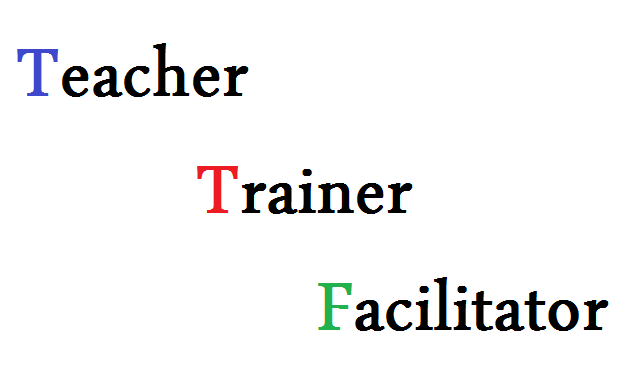
Teacher, Trainer & Facilitator: What’s the Diff?

Image

Well I’ve realized that many “professionals” still mix up between calling them self a teacher/instructor or a trainer or a facilitator. So I felt like sharing the below brief differentiation …this is by no means an academic definition, but rather from my own research and humble experience…so I’m open for all possible suggestions/enhancements. Here it goes…

Teacher/Instructor: Someone who has a sum of knowledge, concepts and theories that he/she transfers via lecturing/presenting to a group of participants.

Facilitator: Someone who has the skills to moderate and run sessions, exercises, discussions and work groups where knowledge is shared by and extracted from the participants themselves.

Trainer: Someone who has knowledge and practical experience in a specific topic that he/she transfers via sessions, exercises, case studies, examples along with presentations and what not. So if you want you can consider a trainer to be a blend between a Teacher/Instructor and a Facilitator. Thus the personal skills are as crucial as the knowledge and expertise of that person.

Now as a matter of fact, the “Job Title” or “Post” doesn’t necessarily dictate what the person does…I’ve seen teachers who actually train in their classes, who are very interactive and utilize a lot more than presenting. At the same time, I’ve seen trainers who actually “Teach” or “Instruct”. Some have a mix where they sometimes teach, sometimes facilitate and sometimes train…so it’s a flexible issue.

What really matters is to know what the person is actually doing… I hope that was somewhat helpful 😉

Other interesting posts:

Volunteering: How It Changed My Life!

volunteer

Believe it or not, volunteer work changed my life. The first time I volunteered I was 11 years old! Yes that young. In fact I’m glad my school (ISC) had something called Student Life Organization (SLO) which engages students in their school life to run this student led organization that acts something like a Student Affairs in a typical school.

Starting at that young age helped me overcome some personal weak points, from shyness to knowing how to interact and deal with people and responsibilities. Yet the seed it planted in me…didn’t stop there, it grew multiple folds to flourish in my university life and beyond.

From the first year of university, I just had that drive to give back to community, to serve, to grow, to meet people and so I ended up joining student societies and clubs at my university (AUB) as well as cofounding an NGO called Aie Serve among my involvement with many others that I am still involved in till this day whether as founder or Board Member or Advisor or simply as a member.

So here are some of the things I believe volunteer work gave me:

  • Opened my mind to new ways of thinking about life.
  • Gave me a purpose beyond my own self and my day to day life.
  • Got me to meet the most inspiring people I would have never dreamed of knowing.
  • Made me more friends that I could have possibly done in 50 years.
  • Gave me life changing experiences and challenges that made me mature way faster than many of my colleagues and friends that were not involved in volunteer work.
  • Made me feel proud about the achievements I was able to accomplish with the teams I worked with to make Lebanon a better place to live in. From improving the life of underserved children to giving back to nature through tree planting and beach cleanups to mentoring youth to training and sharing knowledge with aspiring young leaders to many many maaany more.
  • Gave me opportunities to learn how to manage projects, lead teams, do strategic planning, explore my training skills, brainstorm for ideas that will make the world a better place…just to mention a few.
  • Lead me to having a career in consultancy and training that I wouldn’t have if I didn’t do all the volunteer work I did, simply because a typical university life and a 8-5 job wouldn’t have given me half as much opportunities to learn, grow and meet new people.

So my recommendation to you, no matter how old you are or what your social/economic/academic/marital status is, if you’re not engaged in some volunteer work already, then get to it! You can never do too much volunteer work, the more the merrier, and trust me it just gets better with time, just make sure you join the organizations or causes that you feel passionate about or at least interested in, the rest will follow!

Other interesting posts:

PMI’s International Development CoP Member Spotlight – Afif Tabsh, PMP, CBAP

Dear Friends,

I’m glad to share with you the below interview/article written about me and published in Project Management Institute (PMI’s) International Development Community of Practice. Link to the official article on PMI’s website for PMI Members is here.

Enjoy the below and let me know what you think,

Afif

———————————————————————————————————-

International Development CoP Member Spotlight

Afif Tabsh, PMP, CBAP
Consultant & Trainer at CMCS – Cofounder & President at Aie Serve
Lebanon

About Afif
As a management consultant and trainer at CMCS Lebanon I assist corporations and NGOs in Strategic Planning, Process Improvement, Human Capital Management, Project & Program Management and Leadership. 

I’m especially interested in the fields of Youth Empowerment, Diversity & Acceptance, Leadership, NGO & SME Management, Social Entrepreneurship, Coaching & Consultancy, and Training Techniques.

I’ve participated, organized, trained and was a guest speaker in numerous conferences, camps, workshops, conventions and seminars under Aie Serve, PMI, UNDP, UNESCO, Rotary, Youth Economic Forum, AUB Alumni Council, Arab Economic Form, LAU Peace & Justice Institute among others.

What Does International Development Mean to You?
With our growing interconnected world, global diversity is becoming a key topic on discussion panels as people from all walks of life are becoming interconnected with each other, do business together, volunteer for similar causes, even though they might be thousands of miles away.

Thus respecting differences and accepting the other has become a crucial factor of successful projects, programs and organizations at large, worldwide.

What Are You Most Passionate About?
I’m very passionate about professional volunteering, this has been reflected through the NGOs and clubs I have founded and others that I’m engaged in at the Board level.

Who Is Your Hero & Why?
My biggest hero so far has been my father who was able to balance a very busy life as a doctor with his passion for serving the community and promoting active citizenship along with taking care of his family and private life.

What Is One Strategy for Inclusion that You Can Share?
One of my best strategies is believing in the potential of individuals and focusing on respecting the differences, accepting the other and loving them for their humanity. Every person has a lot of potential to give, it’s just a matter of taking your time to understand them and see things from their perspective, know what they are good at and put it to work. When working in teams, it proves to be the best tool to really utilize the full potential of the team, as you don’t point fingers at them or have a prejudgment that they are incapable, but rather start from the preposition that they have the potential and you’re just there to uncover it.

What Exciting Projects, Programs or Portfolios Are Your Working On? 
I’m currently working on 4 very exciting programs in the volunteer youth NGO I’m leading called Aie Serve (www.AieServe.org – http://www.Facebook.com/AieServe). The programs are:

  • Aie Power – Platform for Youth to Transfer Project Ideas into Reality
  • Aie Consult – Incubator & Consultancy Program for Youth Led NGOs
  • Aie Skills – Training Program to Empower Youth with Soft, Life and Managerial skills
  • Aie Clubs – Network of Youth Lead Clubs in Universities and Local Areas that do Community Development, Service and Awareness Activities

What Is Your Favorite Book & Author?
I have 3 favorite books:

  • Who Moved My Cheese
  • The 7 Habits of Highly Effective People
  • Drive: The Surprising Truth About What Motivates Us 

What Have You Done to Change the World? What Will Your Legacy Be?
One of my proudest achievements is Aie Serve, I cannot say enough about it. I co-founded the organization 6 years ago with a group of friends from all walks of life, different countries, different majors, different ethnicity and different interests but with a shared vision: Serving The Community. From there it grew from a group of friends, to a team and an organization.

The true value of Aie Serve is not just what it does, but the fact that it is run completely by volunteers and the way it is managed internally. The core values of the organization drive it, and drive its programs and way of work. Those core values are simple, yet powerful as they make the way to move forward simple and straight forward.

Our values are: Respect, Acceptance & Love. 

Respecting others’ point of views and beliefs no matter what, accepting differences and considering them the seeds of diversity and finally, loving others for who they are, and not for their background, ethnicity, beliefs, colour or economic status.

If You Weren’t In Project Management, What Would You Be Doing?
If I wasn’t in project management I would be in the field of talent or human capital management. I believe working with, developing, empowering, and supporting people is absolutely crucial for everything we do in this world. Human potential is infinite, thus those who know how to tap into it, grow it and sustain it, will lead success.

Is University Life Only About Academics?

To make a long story short, the answer is: No! Absolutely not!

Here’s a more elaborate answer on why its not only about academics. This topic has recently surfaced to my attention as many have asked me about my university life and what are the keys to success at university.

Now as a matter of fact, and to make things simple, I can break down university life into 4 elements:

University Life

  • Academics: This includes the major you choose, the courses you take, the papers and projects you do, the grades you take…etc. Trust me, this is coming from someone who scored a 99/100 in his first university course and graduated with a GPA of 76/100 after 3 years of study, not because I’m dumb, but rather because I knew that there are other valuable things to focus on.
  • Work Experience: Not everyone has the luxury of having work opportunities in the university like work-study programs or what not. Yet opportunities don’t stop there, a university student can virtually work a gazillion different things from being a waiter/waitress in a nearby restaurant/café to private tutoring for younger students or schools students, to ushering in some events, to joining some company as an intern having any kind of part time job, whether related to their field of study or not. Obviously having the opportunity to work on campus and/or in the field of study is an excellent choice, yet if that is not present, then you don’t have to limit yourself to that…just get into the working mindset and learn how to earn your own money, as early as possible. Again, trust me on the immense impact of earning your own cash, this is coming from someone who worked a multitude of things in university from ushering for events to working in the IT department at university to private tutoring to having an internship, and some were even in parallel!
  • Community Involvement/Extra-curricular Activities: This includes clubs, societies, NGOs, political parties, movements, sports teams, music band or any kind of engagement with the community that gets you to invest in your own hobbies, skills, knowledge and self in general. Again and again, this is coming from someone who started his own NGO with some friends from 1st year of university and was involved in all sorts of clubs, societies, committees and groups all throughout university and beyond.
  • Networking & Connections: Yes this is a crucial element as much as any of the above 3 points. The truth about life is that the more people you know on the personal level, the more connections you have, the higher are probabilities of getting to new career opportunities, academic opportunities and social opportunities. You might even end up meeting the love of your life through one of your connections.  In every step along the way, I made sure I connect with people, truly connect with them and not just have them as acquaintances or someone I once met, but rather making friends, building trust, sharing worries and good times.

Each one of those 4 elements gives you an added value to your knowledge, to your life, to who you are, to the career options you’ll have, and to the people you know. To truly benefit from university life, you got to make use of all what the university life can offer you, whether on or off campus. Again I stress on the fact that perhaps not all universities have extra curricular activities or at least not the ones you want, not all of them will give you work/career choices, but then again the university is not an island, it exists within an ecosystem which you can reach out to and benefit from what it can offer.

For me, this has been one of the key success factors in my life, knowing that there is more university life than just academics. So to all those entering universities, to all the university students out there… don’t just focus on your academic element of university, it wont be enough for this ever changing and challenging world!

Other interesting posts:

NGO: From Charity to Social Enterprise

Image

With the dwindling funds and grants that are available, many NGOs are struggling to survive. They are either shutting down their operations or moving into new fields that have nothing to do with their mission but rather are chasing the money.

Majority of the people I meet, when I tell them “NGO” the first thing that comes to their mind is “Charity”. Now the fact that most NGOs depend on donations, grants and fundraising activities to sustain make it reasonable enough to have people link the word NGO to charity. Nevertheless, new innovative ways in income generation have been making their way to the NGO world.

In this context, and for the past few years, I’ve been advising and consulting NGOs on how to adopt a business model into their operations and projects, to create a shift in how they think about their work in an NGO not only as a way to generate enough income to sustain and grow but also a whole new mindset in what an NGO.

The point I focus on is to transform the NGO from a charity to a social enterprise. This happens when the NGO integrates into its work an income generation model that allows it to make money while leaving the positive impact it hopes for. It’s not just a matter of selling something, but rather a mind shift in how the NGO perceives itself in the community.

So here are few tips I usually share with the NGO leaders on how to go through this transformation:

  • Consider diversifying your income sources; not only donations and grants, but rather start considering fundraising activities, sponsorship,  membership fees, services, products and income generating activities that are aligned with your mission.
  • Income generating activities can be the same exact service you give to your beneficiaries, but include in it a small fee that goes as a donation to your organization. This is step one into becoming a social enterprise. Definitely more complex models can be considered on what services or products are offered for free and which are billable.
  • Invest in R&D to better understand what are the other players is in community, what services do they offer, where can you add value, what does the community really need and what is the best way to package your services/products. Utilize Design Thinking throughout the process, consider empathy and your community, really try to understand what their needs are and how can you package your work in a way that they would be willing to pa for the value they are getting.
  • Invest in Marketing to have a better outreach to your users/beneficiaries, potential partners, donors, sponsors and supporters.
  • Consider that your users/beneficiaries will be willing to pay for a service that fulfills their need, as long as it’s conceived value outweighs its costs. At its core, this is a social business transaction where you are trying to merge social value with the business value. Moreover, it’s important to clarify that the fees they pay will be considered as a donation for the NGO to ensure its sustainability, so that you can serve more people for a longer period of time. This transforms the relationship with your beneficiaries to become service users and partners in the community, a win-win situation for both of you.
  • Develop a Volunteer System into your organization to make it an integral part of its daily work and projects, this in turn gets you more community support, helps you get a better understanding of what the community really needs as the volunteers are most probably going to be from the community itself and it can held reduce running costs on human capital.

The above are just a starting point, but usually are enough to start building on them to transform the NGO from a “Charity” to a “Social Enterprise”. With good analyses, research and hard work, usually NGOs start seeing the impact within a year and will reap its benefits both on the short and long term.

So my advice to all NGO leaders, activists and good-doers, change starts with us. It’s about time we start utilizing some of the lessons learned and best practices in the business world and use them to better serve our communities. So start thinking of how are you going to help your organizations sustain, grow and become more self-dependent on securing its finances rather than having to constantly chase funds, grants and following donor agendas, not for your sake or your staff’s sake, but for the community itself to keep on benefiting.

Other interesting posts:

Aie Serve Animation Video

Dear Friends and Readers,

It is with great pride that I share with you the Animation Video for the NGO that is dearest to my heart, Aie Serve. In this context, I invite you to watch the video, check the website, the Facebook Page  join the organization or share with me ideas if you’d like to collaborate/partner to better serve the youth!

Enjoy!

Afif


Guest Writer: “#1 Business Startup Killer” by Roger Khater

Dear Reader,

I’m glad and proud to present to you my third Guest Writer on the blog, Mr. Roger Khater.

Roger Khater is a Serial Entrepreneur with an Electrical Engineering degree from USJ/ESIB; in addition to his responsibilities as the Managing Director at IP Engineering Pro, he has main board roles and major managerial functions in Caliber Workforce (Human Resources Services) as a Partner and Maktabi (Virtual Office Services) as the Owner. Roger also serves as the President of the PMI Lebanon Chapter.

To know more about Roger, check his LinkedIn Profile or email him at i@rogerkhater.info

Enjoy the read!

Afif

—————————————————————————————————————————————————-

Many entrepreneurs whom I often meet have great business ideas, very few though have a good business plan, and the worst are the ones who only have a fancy website, a distinguished business card but no or not enough clients.

Call me old fashioned but the truth remains, starting a business is all about selling, assuming the business idea is viable. The act of selling involves customers, who are real people after all. So bet on people and invest in relationships.

What is the #1 business startup killer nowadays?

It is the course of actions that is driving our young entrepreneurs into having all the necessary business vehicles, from business identity, to website, to social media, etc… But they forget the key business aspect that is to sell their products or services to real people.

I never recall selling anything to a sheep.

If you have a business idea, don’t waste your time, just sell it. Get your first few customers and leverage on them. Capitalizing on your personal relation, enhance the trust quickly and stay close when needed.

Forget about the shiny stuff, they will eventually come at a later stage.

After a few successful deals, reassess your market in $ value, know your competitors, they exist in one form or another, and only now you can decide if the market size is enough or suitable for you. Embrace this market, make it your target, position your portfolio, have a value proposition and again go sell for more.

If after 2 years you are still stuck with few customers that do not generate enough income, drop the idea, change business line and redo the exercise better. Always ask for help, you need that, secure as many mentors, they will make a difference.

The key to success is gaining customers by selling to people.

The accessories are merely a plus.


Project Management for NGOs Workshop

Dear Readers,

I’d like to invite you to a workshop that I’m organizing and delivering as part of my work with CMCS Lebanon. Details below.

Workshop Topic: Project Management for NGOs
Date:  September 16 & 17, 2013
Time: 9:00am – 5:00pm
Venue: CMCS Lebanon Office – Hamra
Facilitator: Afif Tabsh, PMP®

Target Group:

  • NGO’s Board Members & Founders
  • NGO Consultants
  • Program & Project Managers/ Coordinator/ Assistants
  • General/ Grant Coordinators
  • Team/ Committee/ Task-force Leaders
  • Company Managers with interest in CSR Projects/Programs
  • UN & International Organizations’ Staff

Learning Outcomes:

  • Understand the difference between NGO projects and private sector projects.
  • Understand and identify how to use standard tools and techniques of project management in NGOs.
  • Understand the relationship between the Knowledge Areas in the PMBOK (PMI) in relation to NGO’s terminology and way of work.
  • Understand how to develop a project idea into a full project management plan.

Description:

  • A practical hands-on workshop designed in alignment with the international standard of project management along with the best practices in Project Management in NGOs.
  • Covers key topics and issues that everyone can build on to enhance the way they transform project ideas into fully functioning plans.
  • Includes numerous discussions, reflection sections and exercises.
  • Is approved by AUB and certified by PMI thus PMP/CAPM holder can claim PDUs for it.

Fees:
$ 550 US (including CMCS Customized Course Manual, a Process Chart, Certificate of Attendance, 15 PDUs, and Snacks & Refreshments). VAT included.

For Registration: PM for NGOs Registration Form

For More Information:
OFC: (+961) 1 345111
Mobile: (+961) 71 69000
FAX: (+961) 1 346111
Email: lebanon@cmcs-mena.com

Other Similar Posts About PM and/or NGOs:

Guest Writer: “Effective Communication: Guidelines & Tips” by Dania Dbaibo Darwish

Dear Reader,

As posted earlier, I’m hosting exceptional guest writers on my blog to share some of their experiences, knowledge and perspective that are worth shedding light on.

In this context, my second guest writer is Mrs. Dania Dbaibo Darwish a holder of a BBA & an MA in Psychology from AUB. She is an Associate Certified Professional Life & Career Coach, a Certified Master level NLP practitioner, a Certified Hypnotherapist, & a trained Counselor. She has a background career in Sales & Marketing of consumer goods; & as a Psychology instructor at AUB.  For several years now, she runs her own practice at Coaching Your 3Ps (Personal & Professional Progress) as a Coach, Counselor, Hypnotherapist, & Trainer. Dania is the founding president of the Lebanese Coach Association (LCA) & is very active in other NGOs. She’s known for her dynamic & positive personality.

To get to know her better check:  Website || Blog || LinkedIn || Twitter || YouTube || Facebook  || Pinterest

Enjoy the read!

Afif

—————————————————————————————————————————————————-

You all learned how to talk, but did you all learn how to communicate effectively? Effective and positive communication is an advanced skill that requires your conscious practice and effort until it is mastered. It serves living harmoniously with others, persuading, and influencing family, friends, and colleagues on the job. Once you know few secrets about proper communication, your chances of succeeding in all life domains grow up exponentially. Furthermore, your internal voice will frequently be screaming “Victoryyyy!” in major disagreements as you remain totally agreeable to your counterparts. All it takes is entering the mindset of the person(s) you’re communicating with, and then positively bringing them to your own. As a first step, here are some few guiding essentials for casual conversations, interactions, requests, arguments, or confrontations:

Build rapport: Subtly match and mirror the person you’re talking with (i.e. get in the rhythm of the way they’re speaking, body posture, use of language, etc….). Generally, people who are like each other tend to like each other, so do your best to synchronize your way with theirs.

Listen (don’t just hear): We have two ears and one mouth mainly to listen twice as much as we speak. Instead of mentally rehearsing your next argument, actively listen to what really matters to the other person. Their needs will be your guide to satisfy instead of deviating off-topic.

Words, tone, and body language: In the famous Mehrabian study, these turned out to have an effect of 8%, 37%, and 55% respectively. Never underestimate, therefore, the profound effects of the silent messages behind your unspoken words. It’s “how” you say things that gives much more meaning.

Address them by name often: You’ll be reaching out for their most prominent identity and softly caressing their ego each time. It will sound like flattery.

Maintain eye contact: This ensures you’re retaining connection. It gives the message that you’re interested in what they’re saying and that they’re heard. Remember how it feels when you’re talking to someone and they look away or roll their eyes? Yes…. Utterly disrespectful!

Empathize: Use your interpersonal intelligence and the ability to be in the other person’s shoes to identify with their feeling, ideas, and situation. Ask yourself: what is it like to be in their position. Paraphrase what they’re saying when you can. This conveys that they’re well understood.

Always ask good questions: You can always direct the flow of your conversation through asking open ended questions. This is a sure way to release your counterpart’s defensiveness and probe them to come to mutual conclusions. Avoid giving unsolicited advice till you’re asked.

Once you arm yourself with the above necessities in your interactions, you can further use the following tips to make any point you want with least resistance by your counterpart. You can disagree without being disagreeable; influence while valuing the other person’s stance; and pleasantly direct others’ behavior. Depending on the argument or the situation, you can:

Get them to agree more:  For beginning conversations, ask questions to get them to agree on, say, 3 things. This is part of building rapport. Questions like: the weather is too hot this morning, isn’t it? The traffic was unbearable today, right? You can, then, introduce your request or the point you want to make.

Focus on giving feedback: At times, you’d want to appraise a piece of work or assess a situation. Don’t criticize by just saying what’s not right. Praise the good points as well. As a whole, your opinion will be better received.

Sandwich your feedback: Whenever you have something negative to say, make sure you sandwich it between two positive statements. Start off by complimenting the other person somehow (relevant attributes, qualities, or work); give your negative opinion (in a nice way of course); and then finish up your statements by praising again. These positive statements act as a sandwich buffering any negativity sensed in between.

Feed forward: When you give feedback, you may need to state the preferred scenario for a specific outcome (e.g. behavior or way). It is an assertiveness technique used in relationships (parent to child, or in partnerships) and mentoring. Don’t remain vague about future direction. Probe them by asking questions to get to the ideal response, or suggest it when they don’t know.

Use the “agreement frame”: Nothing beats defensiveness than agreeing first. Use points in your counterpart’s view to agree with, first. Say things like: “I agree that…. And I respect that…. And I really appreciate that….” Then say: “at the same time, I think that…..” stating your disagreement. Never use the word “but” after agreeing. It negates everything you said before it.

The pleasant “no”: Don’t get caught in saying “yes” to others’ requests at your own expense. When you offer an explanation to why you can’t handle their request, you’ll be saying “yes” to yourself. You can start off by saying: “Yes, I appreciate your resorting to me to handle this. I really would like to help you out. At the same time, I have to…..” and list the reasons why you can’t while offering an alternative way or a later time to do it.

Focus on solutions:  Avoid getting sucked up in discussing the problem and rather consider the alternatives to resolving it (more on “win-win” solutions). In doing that, consider the interests and benefits to both of you (you get that through empathetic listening and asking probing questions).

The above tips are really powerful in maintaining positive interactions with others. After all, research shows that for any relationship to thrive, it is necessary to have 5 positive statements to tip off the effect of one negatively stated comment. To become a positive effective communicator requires a conscious decision. With practice, it will become second nature like all other arts to be mastered :)