Compilation: Management & Personal Development

Personal Development

I was asked by some of my friends to compile related articles together in an accessible way. Thus, I’m posting this as a simple compilation of relevant articles under the theme of “Management & Personal Development”.

Check the links below of the aforementioned articles:


I hope you enjoy the articles and feel free to subscribe to my Blog for regular updates.


A Key to Happiness: Love Thy Self!

ImageMy dear reader,

Today, I’m going to share with you a secret of mine that made me find one of the ways to happiness. It’s more intuitive than you might think and I hope it works for you as well 🙂

I’ve went through several transformations in my life and by far the most critical of them was learning to love myself. I’m not talking about being conceited and self centered, that is way too far from what I mean; it’s actually about learning to look in the mirror and really appreciating and loving the person you see.

So what I want you to do after reading this article is to go to the nearest mirror and ask yourself if you love the person you are seeing. Do you appreciate all what this person has been through and what this person became as a result of those experiences? But always remember to be extremely honest to yourself while answering all those questions to be able to identify the way you see yourself.

If your answer is yes, then learn to appreciate yourself more by recognizing and loving that person. This is crucial, simply because the more you love yourself, the easier it would be to really love others and hence open the door for others to love you back.

In my childhood, when I used to look in that mirror, I didn’t really love the person I used to see. I wanted to be different and even completely someone else. I felt like things were missing in me, but as I matured and as things changed in my life, that perception for the person in the mirror changed. All the changes that happened taught me to love myself and love my life.

It’s that moment, that point in time where you start your journey of happiness because happiness is not a destination but rather the journey itself.

You’ll be surprised how your self-perception projects itself on your feelings, actions, attitude and hence your life as a whole. In return, this will influence the way people see you. So, take my brotherly advice and figure out what it takes you to start loving yourself. Only then, life will love you back and you will enjoy your journey full of happiness 🙂

Other Interesting Posts:

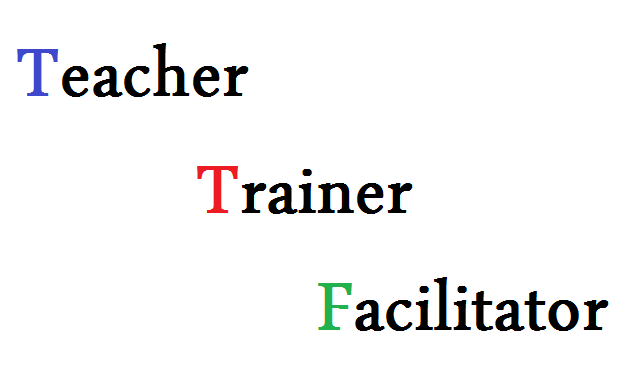
Teacher, Trainer & Facilitator: What’s the Diff?

Image

Well I’ve realized that many “professionals” still mix up between calling them self a teacher/instructor or a trainer or a facilitator. So I felt like sharing the below brief differentiation …this is by no means an academic definition, but rather from my own research and humble experience…so I’m open for all possible suggestions/enhancements. Here it goes…

Teacher/Instructor: Someone who has a sum of knowledge, concepts and theories that he/she transfers via lecturing/presenting to a group of participants.

Facilitator: Someone who has the skills to moderate and run sessions, exercises, discussions and work groups where knowledge is shared by and extracted from the participants themselves.

Trainer: Someone who has knowledge and practical experience in a specific topic that he/she transfers via sessions, exercises, case studies, examples along with presentations and what not. So if you want you can consider a trainer to be a blend between a Teacher/Instructor and a Facilitator. Thus the personal skills are as crucial as the knowledge and expertise of that person.

Now as a matter of fact, the “Job Title” or “Post” doesn’t necessarily dictate what the person does…I’ve seen teachers who actually train in their classes, who are very interactive and utilize a lot more than presenting. At the same time, I’ve seen trainers who actually “Teach” or “Instruct”. Some have a mix where they sometimes teach, sometimes facilitate and sometimes train…so it’s a flexible issue.

What really matters is to know what the person is actually doing… I hope that was somewhat helpful 😉

Other interesting posts:

Volunteering: How It Changed My Life!

volunteer

Believe it or not, volunteer work changed my life. The first time I volunteered I was 11 years old! Yes that young. In fact I’m glad my school (ISC) had something called Student Life Organization (SLO) which engages students in their school life to run this student led organization that acts something like a Student Affairs in a typical school.

Starting at that young age helped me overcome some personal weak points, from shyness to knowing how to interact and deal with people and responsibilities. Yet the seed it planted in me…didn’t stop there, it grew multiple folds to flourish in my university life and beyond.

From the first year of university, I just had that drive to give back to community, to serve, to grow, to meet people and so I ended up joining student societies and clubs at my university (AUB) as well as cofounding an NGO called Aie Serve among my involvement with many others that I am still involved in till this day whether as founder or Board Member or Advisor or simply as a member.

So here are some of the things I believe volunteer work gave me:

  • Opened my mind to new ways of thinking about life.
  • Gave me a purpose beyond my own self and my day to day life.
  • Got me to meet the most inspiring people I would have never dreamed of knowing.
  • Made me more friends that I could have possibly done in 50 years.
  • Gave me life changing experiences and challenges that made me mature way faster than many of my colleagues and friends that were not involved in volunteer work.
  • Made me feel proud about the achievements I was able to accomplish with the teams I worked with to make Lebanon a better place to live in. From improving the life of underserved children to giving back to nature through tree planting and beach cleanups to mentoring youth to training and sharing knowledge with aspiring young leaders to many many maaany more.
  • Gave me opportunities to learn how to manage projects, lead teams, do strategic planning, explore my training skills, brainstorm for ideas that will make the world a better place…just to mention a few.
  • Lead me to having a career in consultancy and training that I wouldn’t have if I didn’t do all the volunteer work I did, simply because a typical university life and a 8-5 job wouldn’t have given me half as much opportunities to learn, grow and meet new people.

So my recommendation to you, no matter how old you are or what your social/economic/academic/marital status is, if you’re not engaged in some volunteer work already, then get to it! You can never do too much volunteer work, the more the merrier, and trust me it just gets better with time, just make sure you join the organizations or causes that you feel passionate about or at least interested in, the rest will follow!

Other interesting posts:

NGO: From Charity to Social Enterprise

Image

With the dwindling funds and grants that are available, many NGOs are struggling to survive. They are either shutting down their operations or moving into new fields that have nothing to do with their mission but rather are chasing the money.

Majority of the people I meet, when I tell them “NGO” the first thing that comes to their mind is “Charity”. Now the fact that most NGOs depend on donations, grants and fundraising activities to sustain make it reasonable enough to have people link the word NGO to charity. Nevertheless, new innovative ways in income generation have been making their way to the NGO world.

In this context, and for the past few years, I’ve been advising and consulting NGOs on how to adopt a business model into their operations and projects, to create a shift in how they think about their work in an NGO not only as a way to generate enough income to sustain and grow but also a whole new mindset in what an NGO.

The point I focus on is to transform the NGO from a charity to a social enterprise. This happens when the NGO integrates into its work an income generation model that allows it to make money while leaving the positive impact it hopes for. It’s not just a matter of selling something, but rather a mind shift in how the NGO perceives itself in the community.

So here are few tips I usually share with the NGO leaders on how to go through this transformation:

  • Consider diversifying your income sources; not only donations and grants, but rather start considering fundraising activities, sponsorship,  membership fees, services, products and income generating activities that are aligned with your mission.
  • Income generating activities can be the same exact service you give to your beneficiaries, but include in it a small fee that goes as a donation to your organization. This is step one into becoming a social enterprise. Definitely more complex models can be considered on what services or products are offered for free and which are billable.
  • Invest in R&D to better understand what are the other players is in community, what services do they offer, where can you add value, what does the community really need and what is the best way to package your services/products. Utilize Design Thinking throughout the process, consider empathy and your community, really try to understand what their needs are and how can you package your work in a way that they would be willing to pa for the value they are getting.
  • Invest in Marketing to have a better outreach to your users/beneficiaries, potential partners, donors, sponsors and supporters.
  • Consider that your users/beneficiaries will be willing to pay for a service that fulfills their need, as long as it’s conceived value outweighs its costs. At its core, this is a social business transaction where you are trying to merge social value with the business value. Moreover, it’s important to clarify that the fees they pay will be considered as a donation for the NGO to ensure its sustainability, so that you can serve more people for a longer period of time. This transforms the relationship with your beneficiaries to become service users and partners in the community, a win-win situation for both of you.
  • Develop a Volunteer System into your organization to make it an integral part of its daily work and projects, this in turn gets you more community support, helps you get a better understanding of what the community really needs as the volunteers are most probably going to be from the community itself and it can held reduce running costs on human capital.

The above are just a starting point, but usually are enough to start building on them to transform the NGO from a “Charity” to a “Social Enterprise”. With good analyses, research and hard work, usually NGOs start seeing the impact within a year and will reap its benefits both on the short and long term.

So my advice to all NGO leaders, activists and good-doers, change starts with us. It’s about time we start utilizing some of the lessons learned and best practices in the business world and use them to better serve our communities. So start thinking of how are you going to help your organizations sustain, grow and become more self-dependent on securing its finances rather than having to constantly chase funds, grants and following donor agendas, not for your sake or your staff’s sake, but for the community itself to keep on benefiting.

Other interesting posts:

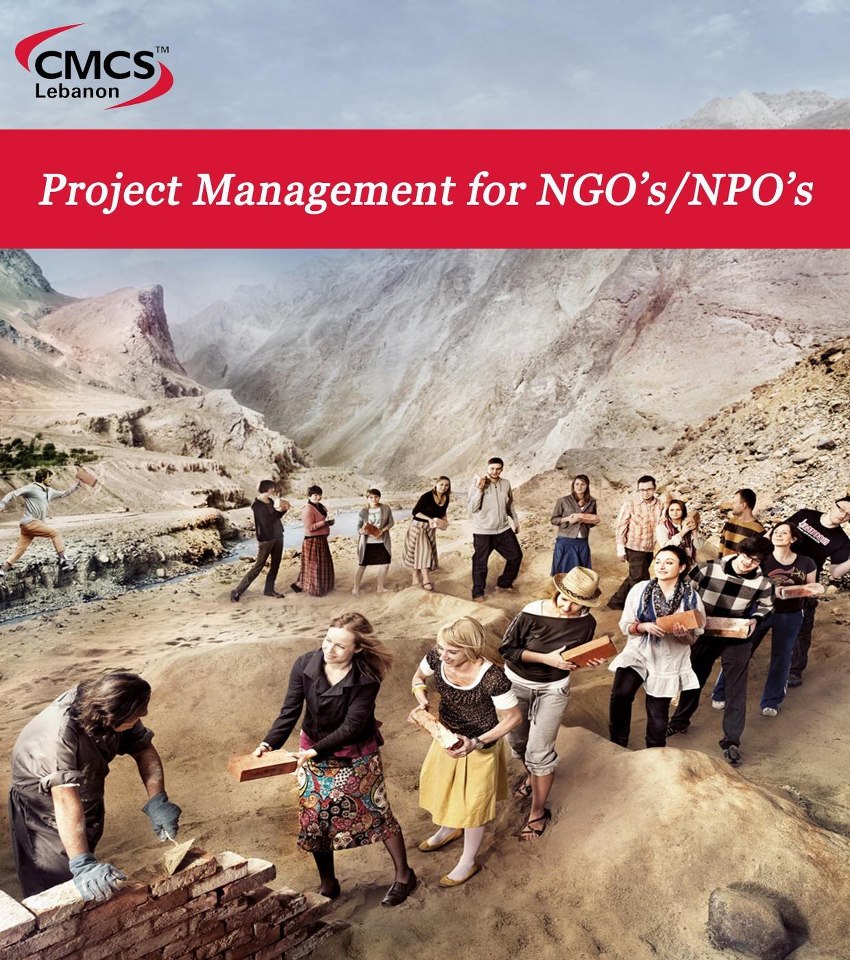
Project Management for NGOs Workshop

Dear Readers,

I’d like to invite you to a workshop that I’m organizing and delivering as part of my work with CMCS Lebanon. Details below.

Workshop Topic: Project Management for NGOs
Date:  September 16 & 17, 2013
Time: 9:00am – 5:00pm
Venue: CMCS Lebanon Office – Hamra
Facilitator: Afif Tabsh, PMP®

Target Group:

  • NGO’s Board Members & Founders
  • NGO Consultants
  • Program & Project Managers/ Coordinator/ Assistants
  • General/ Grant Coordinators
  • Team/ Committee/ Task-force Leaders
  • Company Managers with interest in CSR Projects/Programs
  • UN & International Organizations’ Staff

Learning Outcomes:

  • Understand the difference between NGO projects and private sector projects.
  • Understand and identify how to use standard tools and techniques of project management in NGOs.
  • Understand the relationship between the Knowledge Areas in the PMBOK (PMI) in relation to NGO’s terminology and way of work.
  • Understand how to develop a project idea into a full project management plan.

Description:

  • A practical hands-on workshop designed in alignment with the international standard of project management along with the best practices in Project Management in NGOs.
  • Covers key topics and issues that everyone can build on to enhance the way they transform project ideas into fully functioning plans.
  • Includes numerous discussions, reflection sections and exercises.
  • Is approved by AUB and certified by PMI thus PMP/CAPM holder can claim PDUs for it.

Fees:
$ 550 US (including CMCS Customized Course Manual, a Process Chart, Certificate of Attendance, 15 PDUs, and Snacks & Refreshments). VAT included.

For Registration: PM for NGOs Registration Form

For More Information:
OFC: (+961) 1 345111
Mobile: (+961) 71 69000
FAX: (+961) 1 346111
Email: lebanon@cmcs-mena.com

Other Similar Posts About PM and/or NGOs: