Why Arabs Won’t Rise Up Anytime Soon

Image

Building on my humble knowledge, I get to have some observations and analysis of the world I live in. So here’s one for the day: Arabs won’t rise up anytime soon!

My aim here is not to push you  to lose hope on Arabs progress, but rather trying to shed light on certain elements of why are the Arab nations still way behind in terms of technology, economy, civil-rights, and politics, just to name a few.

Yes, I’m an Arab and I sadly got to the conviction that Arabs won’t rise up anytime soon. If you observe how nations grew into world powers you will realize that most of them have two main factors in common: Institutionalization and care for public good. Apparently, those two factors are missing (either one or both) from almost all Arab countries!

We’re mostly an individualistic nation: a nation formed of hundreds of millions of individuals who want to shine individually rather than as a nation. Collaborating together for the common good in a well-structured and institutionalized manner is something perhaps beyond the short-term wins that those individuals perceive.

We dislike systems, processes, policies, procedures, long term goals and the common good when it contradicts with personal gain and hence we try to avoid them as much as we could! So if we can avoid filling a form, not follow a procedure, rule, or policy (or at least get away with it), take a shortcut, or go for a quick win, we’d will go for it.

Examples of what I mean here can be as small as not standing in line whenever there is a queue to not stopping on a red light or following the road signs. It can also be as major as politicians not acting as part of an institution with a system, but rather acting like heads of mafias, bending and changing the rules, the governmental institutions and policies to fit their own needs and desires. The bigger problem is not that they do it, but rather no one actually holds them accountable for what they do. Many people accept such a behavior and thus the issue exacerbates with time. Even with the so-called “Arab Spring” and the people rising to demand for their rights, the same thing was done all over again, “leaders” took charge and bent rules to fit them and their “group”.

Just to be fair, there are some positive deviants from the norm, like in Dubai and Abu Dhabi, where they actually plan years ahead, put systems and policy in place, and do proper enforcement and follow up. In Egypt, though millions go on demonstration, they leave the roads clean and ensure things are properly back in place.

Nevertheless, most of us are always chasing the quick wins, the individual recognitions, the shortcuts and the “what’s in it for me” attitude, at least for the time being. So in a nutshell, we’re mostly an individualistic nation, we produce endless shining stars but not a collaborative galaxy!

My recommendation would be to start learning the following, so we can perhaps start taking baby steps towards progress:

  • Willingness to learn, humbleness, and long term strategic planning from the Japanese
  • Willingness to put the nation before self, economic agility and discipline from the Chinese
  • Structuring and building systems, pragmatic thinking and financial wizardry from the Americans
  • Strength and value of team work and communal wellbeing from the Penguins
  • Perseverance, discipline and working as one from the Ants

I’m saying all of this not with a perspective of despair but rather a belief that everything is feasible and if we learn to change how we think and act, we can definitely do wonders.


Other Articles That Might Be of Interest:

Compilation: Management & Personal Development

Personal Development

I was asked by some of my friends to compile related articles together in an accessible way. Thus, I’m posting this as a simple compilation of relevant articles under the theme of “Management & Personal Development”.

Check the links below of the aforementioned articles:


I hope you enjoy the articles and feel free to subscribe to my Blog for regular updates.


A Key to Happiness: Love Thy Self!

ImageMy dear reader,

Today, I’m going to share with you a secret of mine that made me find one of the ways to happiness. It’s more intuitive than you might think and I hope it works for you as well 🙂

I’ve went through several transformations in my life and by far the most critical of them was learning to love myself. I’m not talking about being conceited and self centered, that is way too far from what I mean; it’s actually about learning to look in the mirror and really appreciating and loving the person you see.

So what I want you to do after reading this article is to go to the nearest mirror and ask yourself if you love the person you are seeing. Do you appreciate all what this person has been through and what this person became as a result of those experiences? But always remember to be extremely honest to yourself while answering all those questions to be able to identify the way you see yourself.

If your answer is yes, then learn to appreciate yourself more by recognizing and loving that person. This is crucial, simply because the more you love yourself, the easier it would be to really love others and hence open the door for others to love you back.

In my childhood, when I used to look in that mirror, I didn’t really love the person I used to see. I wanted to be different and even completely someone else. I felt like things were missing in me, but as I matured and as things changed in my life, that perception for the person in the mirror changed. All the changes that happened taught me to love myself and love my life.

It’s that moment, that point in time where you start your journey of happiness because happiness is not a destination but rather the journey itself.

You’ll be surprised how your self-perception projects itself on your feelings, actions, attitude and hence your life as a whole. In return, this will influence the way people see you. So, take my brotherly advice and figure out what it takes you to start loving yourself. Only then, life will love you back and you will enjoy your journey full of happiness 🙂

Other Interesting Posts:

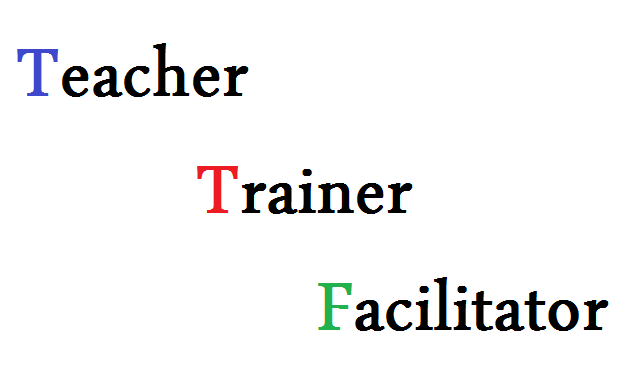
Teacher, Trainer & Facilitator: What’s the Diff?

Image

Well I’ve realized that many “professionals” still mix up between calling them self a teacher/instructor or a trainer or a facilitator. So I felt like sharing the below brief differentiation …this is by no means an academic definition, but rather from my own research and humble experience…so I’m open for all possible suggestions/enhancements. Here it goes…

Teacher/Instructor: Someone who has a sum of knowledge, concepts and theories that he/she transfers via lecturing/presenting to a group of participants.

Facilitator: Someone who has the skills to moderate and run sessions, exercises, discussions and work groups where knowledge is shared by and extracted from the participants themselves.

Trainer: Someone who has knowledge and practical experience in a specific topic that he/she transfers via sessions, exercises, case studies, examples along with presentations and what not. So if you want you can consider a trainer to be a blend between a Teacher/Instructor and a Facilitator. Thus the personal skills are as crucial as the knowledge and expertise of that person.

Now as a matter of fact, the “Job Title” or “Post” doesn’t necessarily dictate what the person does…I’ve seen teachers who actually train in their classes, who are very interactive and utilize a lot more than presenting. At the same time, I’ve seen trainers who actually “Teach” or “Instruct”. Some have a mix where they sometimes teach, sometimes facilitate and sometimes train…so it’s a flexible issue.

What really matters is to know what the person is actually doing… I hope that was somewhat helpful 😉

Other interesting posts:

An Added Value of Being Lebanese

Lebanon

The more I interact with people from around the world, the more I travel, the more I work with different cultures, nationalities and what not I become prouder and prouder of being Lebanese.

I’ve realized that as Lebanese, we become hard wired to be resilient, adaptable, expansive and global.

I’m yet to see a country where you don’t find a Lebanese community in it, and you somehow always find them adapting to that community, learning its ways, spreading their wings and flying high among the community members.

If you were born to a Lebanese origin, you automatically entered a network of individuals spread all around the globe. You automatically grow to understand your role in this ever changing world, you get to consider wider perspectives and ambitions than many other nationalities I’ve seen…you get the mindset that the world is just a small village, and no matter where you go…you’ll manage, not because you got some super powers, but rather because we grow up engaged with the globe…studying in one country, working in another, having relatives and friends around the globe…and that’s not only because of the political or economic situation in Lebanon, even ages ago when things were all better in Lebanon…Lebanese still were wide spread.

So in a nutshell, being Lebanese, you got that added value of being, by default, a global citizen!

To all my fellow Lebanese around the globe, I’m proud of you…shine on!

PMI’s International Development CoP Member Spotlight – Afif Tabsh, PMP, CBAP

Dear Friends,

I’m glad to share with you the below interview/article written about me and published in Project Management Institute (PMI’s) International Development Community of Practice. Link to the official article on PMI’s website for PMI Members is here.

Enjoy the below and let me know what you think,

Afif

———————————————————————————————————-

International Development CoP Member Spotlight

Afif Tabsh, PMP, CBAP
Consultant & Trainer at CMCS – Cofounder & President at Aie Serve
Lebanon

About Afif
As a management consultant and trainer at CMCS Lebanon I assist corporations and NGOs in Strategic Planning, Process Improvement, Human Capital Management, Project & Program Management and Leadership. 

I’m especially interested in the fields of Youth Empowerment, Diversity & Acceptance, Leadership, NGO & SME Management, Social Entrepreneurship, Coaching & Consultancy, and Training Techniques.

I’ve participated, organized, trained and was a guest speaker in numerous conferences, camps, workshops, conventions and seminars under Aie Serve, PMI, UNDP, UNESCO, Rotary, Youth Economic Forum, AUB Alumni Council, Arab Economic Form, LAU Peace & Justice Institute among others.

What Does International Development Mean to You?
With our growing interconnected world, global diversity is becoming a key topic on discussion panels as people from all walks of life are becoming interconnected with each other, do business together, volunteer for similar causes, even though they might be thousands of miles away.

Thus respecting differences and accepting the other has become a crucial factor of successful projects, programs and organizations at large, worldwide.

What Are You Most Passionate About?
I’m very passionate about professional volunteering, this has been reflected through the NGOs and clubs I have founded and others that I’m engaged in at the Board level.

Who Is Your Hero & Why?
My biggest hero so far has been my father who was able to balance a very busy life as a doctor with his passion for serving the community and promoting active citizenship along with taking care of his family and private life.

What Is One Strategy for Inclusion that You Can Share?
One of my best strategies is believing in the potential of individuals and focusing on respecting the differences, accepting the other and loving them for their humanity. Every person has a lot of potential to give, it’s just a matter of taking your time to understand them and see things from their perspective, know what they are good at and put it to work. When working in teams, it proves to be the best tool to really utilize the full potential of the team, as you don’t point fingers at them or have a prejudgment that they are incapable, but rather start from the preposition that they have the potential and you’re just there to uncover it.

What Exciting Projects, Programs or Portfolios Are Your Working On? 
I’m currently working on 4 very exciting programs in the volunteer youth NGO I’m leading called Aie Serve (www.AieServe.org – http://www.Facebook.com/AieServe). The programs are:

  • Aie Power – Platform for Youth to Transfer Project Ideas into Reality
  • Aie Consult – Incubator & Consultancy Program for Youth Led NGOs
  • Aie Skills – Training Program to Empower Youth with Soft, Life and Managerial skills
  • Aie Clubs – Network of Youth Lead Clubs in Universities and Local Areas that do Community Development, Service and Awareness Activities

What Is Your Favorite Book & Author?
I have 3 favorite books:

  • Who Moved My Cheese
  • The 7 Habits of Highly Effective People
  • Drive: The Surprising Truth About What Motivates Us 

What Have You Done to Change the World? What Will Your Legacy Be?
One of my proudest achievements is Aie Serve, I cannot say enough about it. I co-founded the organization 6 years ago with a group of friends from all walks of life, different countries, different majors, different ethnicity and different interests but with a shared vision: Serving The Community. From there it grew from a group of friends, to a team and an organization.

The true value of Aie Serve is not just what it does, but the fact that it is run completely by volunteers and the way it is managed internally. The core values of the organization drive it, and drive its programs and way of work. Those core values are simple, yet powerful as they make the way to move forward simple and straight forward.

Our values are: Respect, Acceptance & Love. 

Respecting others’ point of views and beliefs no matter what, accepting differences and considering them the seeds of diversity and finally, loving others for who they are, and not for their background, ethnicity, beliefs, colour or economic status.

If You Weren’t In Project Management, What Would You Be Doing?
If I wasn’t in project management I would be in the field of talent or human capital management. I believe working with, developing, empowering, and supporting people is absolutely crucial for everything we do in this world. Human potential is infinite, thus those who know how to tap into it, grow it and sustain it, will lead success.

NGO: From Charity to Social Enterprise

Image

With the dwindling funds and grants that are available, many NGOs are struggling to survive. They are either shutting down their operations or moving into new fields that have nothing to do with their mission but rather are chasing the money.

Majority of the people I meet, when I tell them “NGO” the first thing that comes to their mind is “Charity”. Now the fact that most NGOs depend on donations, grants and fundraising activities to sustain make it reasonable enough to have people link the word NGO to charity. Nevertheless, new innovative ways in income generation have been making their way to the NGO world.

In this context, and for the past few years, I’ve been advising and consulting NGOs on how to adopt a business model into their operations and projects, to create a shift in how they think about their work in an NGO not only as a way to generate enough income to sustain and grow but also a whole new mindset in what an NGO.

The point I focus on is to transform the NGO from a charity to a social enterprise. This happens when the NGO integrates into its work an income generation model that allows it to make money while leaving the positive impact it hopes for. It’s not just a matter of selling something, but rather a mind shift in how the NGO perceives itself in the community.

So here are few tips I usually share with the NGO leaders on how to go through this transformation:

  • Consider diversifying your income sources; not only donations and grants, but rather start considering fundraising activities, sponsorship,  membership fees, services, products and income generating activities that are aligned with your mission.
  • Income generating activities can be the same exact service you give to your beneficiaries, but include in it a small fee that goes as a donation to your organization. This is step one into becoming a social enterprise. Definitely more complex models can be considered on what services or products are offered for free and which are billable.
  • Invest in R&D to better understand what are the other players is in community, what services do they offer, where can you add value, what does the community really need and what is the best way to package your services/products. Utilize Design Thinking throughout the process, consider empathy and your community, really try to understand what their needs are and how can you package your work in a way that they would be willing to pa for the value they are getting.
  • Invest in Marketing to have a better outreach to your users/beneficiaries, potential partners, donors, sponsors and supporters.
  • Consider that your users/beneficiaries will be willing to pay for a service that fulfills their need, as long as it’s conceived value outweighs its costs. At its core, this is a social business transaction where you are trying to merge social value with the business value. Moreover, it’s important to clarify that the fees they pay will be considered as a donation for the NGO to ensure its sustainability, so that you can serve more people for a longer period of time. This transforms the relationship with your beneficiaries to become service users and partners in the community, a win-win situation for both of you.
  • Develop a Volunteer System into your organization to make it an integral part of its daily work and projects, this in turn gets you more community support, helps you get a better understanding of what the community really needs as the volunteers are most probably going to be from the community itself and it can held reduce running costs on human capital.

The above are just a starting point, but usually are enough to start building on them to transform the NGO from a “Charity” to a “Social Enterprise”. With good analyses, research and hard work, usually NGOs start seeing the impact within a year and will reap its benefits both on the short and long term.

So my advice to all NGO leaders, activists and good-doers, change starts with us. It’s about time we start utilizing some of the lessons learned and best practices in the business world and use them to better serve our communities. So start thinking of how are you going to help your organizations sustain, grow and become more self-dependent on securing its finances rather than having to constantly chase funds, grants and following donor agendas, not for your sake or your staff’s sake, but for the community itself to keep on benefiting.

Other interesting posts:

Project Management for NGOs Workshop

Dear Readers,

I’d like to invite you to a workshop that I’m organizing and delivering as part of my work with CMCS Lebanon. Details below.

Workshop Topic: Project Management for NGOs
Date:  September 16 & 17, 2013
Time: 9:00am – 5:00pm
Venue: CMCS Lebanon Office – Hamra
Facilitator: Afif Tabsh, PMP®

Target Group:

  • NGO’s Board Members & Founders
  • NGO Consultants
  • Program & Project Managers/ Coordinator/ Assistants
  • General/ Grant Coordinators
  • Team/ Committee/ Task-force Leaders
  • Company Managers with interest in CSR Projects/Programs
  • UN & International Organizations’ Staff

Learning Outcomes:

  • Understand the difference between NGO projects and private sector projects.
  • Understand and identify how to use standard tools and techniques of project management in NGOs.
  • Understand the relationship between the Knowledge Areas in the PMBOK (PMI) in relation to NGO’s terminology and way of work.
  • Understand how to develop a project idea into a full project management plan.

Description:

  • A practical hands-on workshop designed in alignment with the international standard of project management along with the best practices in Project Management in NGOs.
  • Covers key topics and issues that everyone can build on to enhance the way they transform project ideas into fully functioning plans.
  • Includes numerous discussions, reflection sections and exercises.
  • Is approved by AUB and certified by PMI thus PMP/CAPM holder can claim PDUs for it.

Fees:
$ 550 US (including CMCS Customized Course Manual, a Process Chart, Certificate of Attendance, 15 PDUs, and Snacks & Refreshments). VAT included.

For Registration: PM for NGOs Registration Form

For More Information:
OFC: (+961) 1 345111
Mobile: (+961) 71 69000
FAX: (+961) 1 346111
Email: lebanon@cmcs-mena.com

Other Similar Posts About PM and/or NGOs: